|
| My kitchen essentials |
See this post for the first part of this series.
If
you are an inexperienced cook who wants to eat real, whole foods and
avoid processed foodlike products, you have your work cut out for you.
If you are used to using your can opener more than your cutting board,
it is going to take some effort on your part to change those habits and
learn new skills to help you cook quickly, efficiently and well.
If
you have never really cooked with raw ingredients before, don't let
that scare you off. If I move too fast or leave out a step, leave a
comment and I'll try to help you out. If you work at it every day,
pretty soon you will develop the necessary skills and you'll be so proud
of your new abilities. In the even of World War Z, you will have mad
zombi chopping knife skills.
Before
you start cooking, you will want to have certain tools. There is
nothing fancy or too specialized here. Nearly everything listed I have
seen in a thrift shop at some point or another, and half of what I have
here (including both my cast-iron pans and all my mixing bowls) were
thrifted.
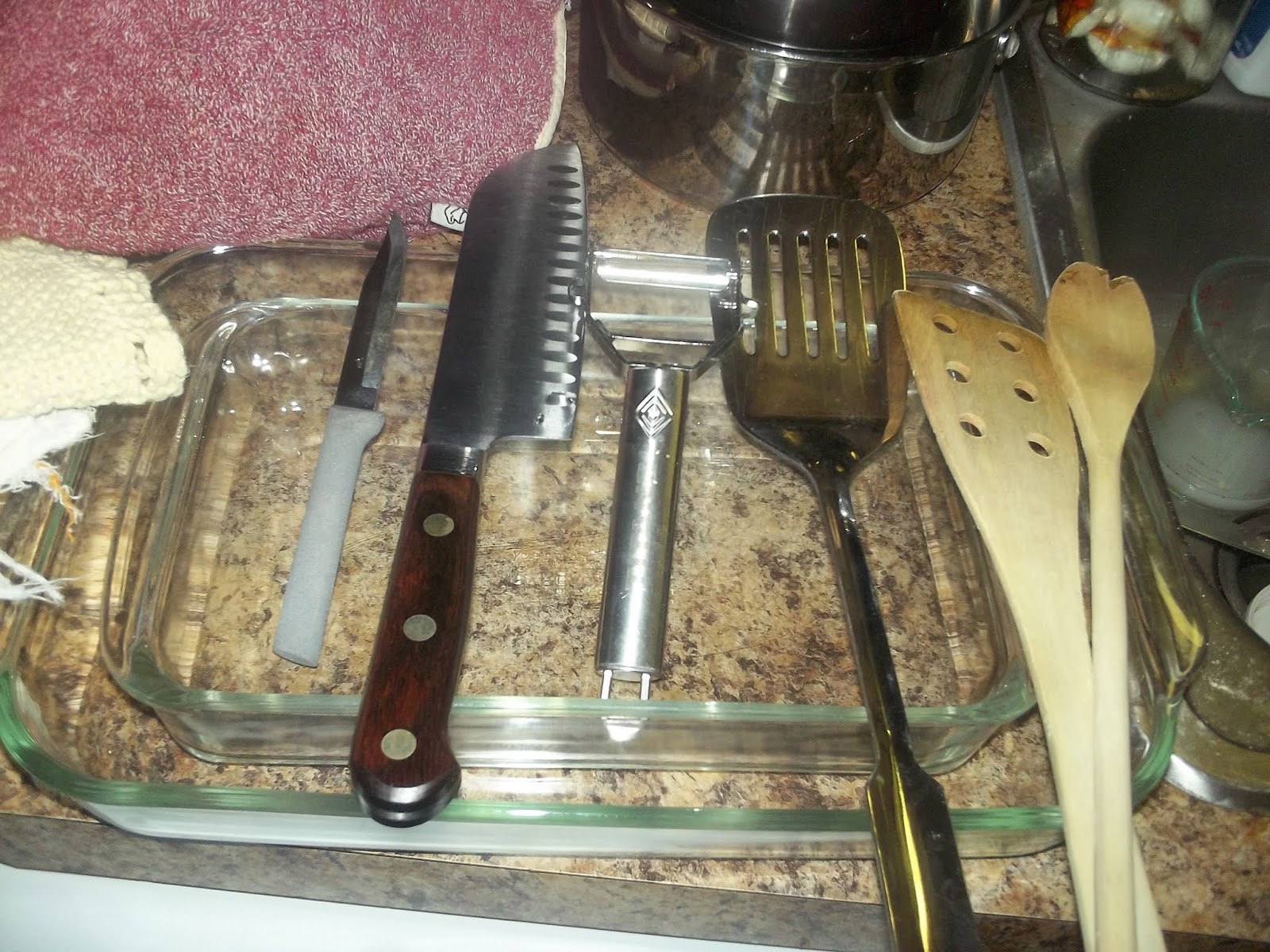
Wooden spoons. Various sizes. I use these workhorses all the time. I have some pretty cheap and flimsy ones, but I keep meaning to look for better ones in the thrift shop.
Sturdy spatula. I like a one-piece construction.
Sharp* chopping knife, any shape you prefer Mine is a
LamsonSharp Rosewood Forged
7" Santoku. Husband gave it to me for Valentine's one year - I'm fairly certain he got it at a steep discount.
Sharp* paring knife I have a few cheap ones that I keep sharp.
Vegetable peeler. A friend gave me the Titan Peeler and I thought she was crazy but I love that thing and use it constantly. Still going strong, 3 years and counting.
Forks and spoons
Yes, regular ones from the cutlery drawer. I prefer a fork to a whisk
for most beating tasks, and I mostly eyeball measurements with spoons.
Baking dishes, different sizes. Obviously
I'm partial to Pyrex, and I often find them at the thrift shop for $3
or less. I have a nice collection of these dishes and I use them for
everything, from roasting a chicken to storing leftovers to catching
potential drips from thawing food. You might prefer a ceramic or metal pan.
Saucepans in various sizes.
Quality is important. Stainless steel, heavy bottoms, if you can afford
them. Keep your eyes peeled in the thrift shop for these - they clean
up well but don't stick around long!
Vegetable steamer basket. I use mine all. the. time. It is very easy to toss a bag of frozen peas, green beans, or broccoli (our favorite green veggies).
Medium skillet. I like cast iron. I
would advise you to be wary of special non-stick coatings on metal
pans. I'm not going to throw any science at your head, but I would urge
you to do a bit of research. I never used them when I was learning to
cook, and I don't own any now, so I've never researched the subject.
Griddle. I have a cast-iron
comal that I often use for toasting tortillas and sandwiches, or cooking pancakes. Since I only use it for these applications, it's always clean and ready to quickly do whatever I need it to do.
Mixing bowls. Various sizes. I used to use stainless steel
but my Pyrex/thrift shop obsession has taken over. The more the merrier
is my attitude towards bowls. I have 4 smalls and 4 larges and you
wouldn't believe the number of times I can't find a bowl!
Cutting boards. (not
pictured) I like a nice big cutting board, so that I can chop quickly
without worrying about pieces skidding off onto the floor or into the
sink. If you are tight on space, look for a large wooden one that will span your sink.
I prefer wood for most of my chopping (it's easier on the knives), but I
use plastic for meat, because it's easily sanitized in the dishwasher.
Oven mitts.
Don't skimp on this! Take good care of all your kitchen equipment, that
includes your hands! I love my Pampered Chef oven mitts, I thought they
were the best in the whole world, until a friend let me use her
Ove-gloves. Wow. She had one brand-name, and one knockoff that she found at Aldi. Both worked really well. They are going on my Christmas list for sure!
Dish towels and dish cloths. This is essential. Keep our
hands and work surface clean to avoid cross-contamination and prevent
illness. Unfortunately this photo was taken on laundry day, so you can
see my rattiest towel and cloth. I hate damp towels and smelly
dishcloths, so I change them at least once a day.
Scrub brush. (not pictured) I have an aversion to
sponges, so for clean up I rely on my scrub brushes. I have several
cheap plastic ones with long handles from Ikea, and wash them in the
dishwasher after each use.
Conclusion
The
"right" tools are a matter of opinion. I've tried to stick to the very
basic things that I use every single time I cook. Your essentials list
will probably look different from mine. Most important, try to have your
essential tools near to hand. The best quality tools are of little use to the busy cook if you can't grab them in 30 seconds or less.
What tools are on your kitchen essentials list?
*A
sharp knife is so important. You will have to spend less time and exert
less energy when your knife is sharp, and as a bonus, you'll cut
yourself less. I have a couple of good knives that I love, and I learned
to sharpen them myself with a simple, $10 whetstone from amazon. If you
don't want to learn, don't have the time, or don't want to risk ruining
a good knife (I practiced on crummy knives first), google your zipcode
plus "knife sharpening" or visit your local sewing shop and check near
the register. They will normally have flyers about local scissor
sharpeners, and those guys will also do your kitchen knives.
This post is shared with Scratch Cookin' 4/17/12